Level II Lower Quadrant Lumbar
Mobilization Techniques
Disclaimer:
The assessment and treatment techniques depicted
or described in this site are not intended to replace
formal instruction in orthopaedic manual therapy or
any other type of physical therapy. They are intended
to review, augment and facilitate the knowledge and
skills previously gained on manual therapy or other
courses. The author takes no responsibility for the
use of these techniques by users of this site. |
11. Flexion and contralateral
sideflexion from below using pelvis.
Stabilize L4 with cranial
hand. Use caudal arm to draw pelvis and L5 caudal (arrow
A). Also use caudal arm to produce a posterior sagittal
rotation of the pelvis to induce flexion (arrow B). Push
pelvis posterior with chest to induce a posterior translation
(arrow C). This will induce a flexion, contralateral (left)
sideflexion of L4/5. Flexion and left sideflexion combined
produce maximum flexion at the right zygapophyseal joint.
Therefore, this technique targets the right side (closest
to ceiling) (symbol D).

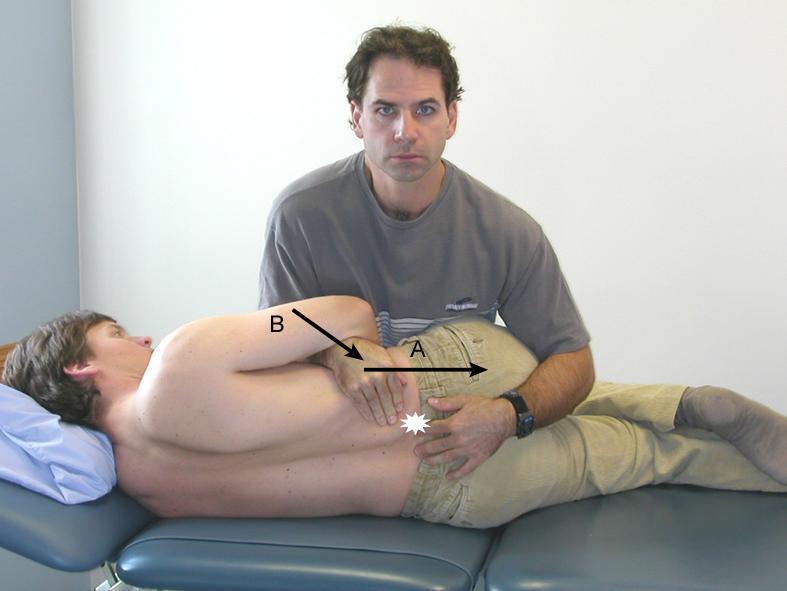
12. Extension and ipsilateral
sideflexion from above.
Stabilize L5 with caudal
hand. Use cranial arm to push thorax and L4 caudal (arrow
A). Also push thorax and L4 posterior (arrow B). This will
induce extension, ipsilateral (right) sideflexion at L4/5.
This technique targets the right side (closest to ceiling)
(symbol).