
Understanding Shoulder Bankart and Hill-Sachs Lesions
In our last post, I discussed shoulder dislocations and briefly mentioned two additional injuries that individuals can suffer when they dislocate their shoulder: Bankart lesions and Hill-Sachs lesions. While these injuries sometimes occur together with a dislocation, they affect different structures of the shoulder and can have different implications for treatment and recovery. With this final post of 2025, I will dive deeper into these injuries and hopefully give you a better understanding of their significance in shoulder dislocations.
A Quick Review of Shoulder Anatomy
The shoulder is a ball-and-socket joint made up of the humeral head (ball), the glenoid fossa of the scapula (socket), and a rim of cartilage called the labrum. The labrum deepens the socket of the bony glenoid, and improves shoulder stability. Because the shoulder has the greatest mobility of any joint in the human body, it is also more prone to dislocation. For a more detailed look at the shoulder and its anatomy, please see our most recent post HERE.
What Is a Bankart Lesion?
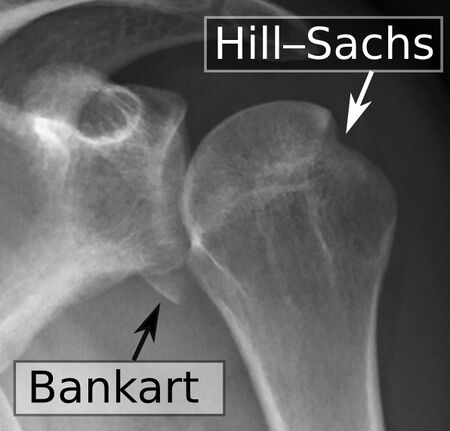
A Bankart lesion is an injury to the “socket” of the shoulder. Bankart lesions commonly involve some tearing of the labrum away from the bony socket of the joint. Dislocations can also cause a bony Bankart lesion, where a piece of the glenoid fossa is broken off during the shoulder dislocation. As the humeral head (ball) slides forward during a dislocation, it either tears the labrum away from the glenoid (socket), or chips off a portion of the bony glenoid (or both). The glenoid fossa and labrum play a critical role in the stability of the shoulder. When injured, damage to these structures can lead to repeated shoulder dislocations.
Symptoms of a Bankart lesion can include pain with movement, reduced shoulder range of motion, and potentially a loss of strength in the shoulder. Patients often describe joint noises, ‘catching’ or ‘clicking’, and sometimes a feeling of instability (feeling like the shoulder may “give out”), especially with overhead or throwing movements.
What Is a Hill-Sachs Lesion?
A Hill-Sachs lesion is a bony injury or ‘dent’ in the postero-lateral (back-side) of the humeral head. These lesions are not uncommon with shoulder dislocations. They occur when the humeral head forcefully impacts the edge of the glenoid (socket). Small Hill-Sachs lesions can be asymptomatic, but larger lesions can cause instability and lead to further dislocations or subluxations. Hill-Sachs lesions are often painless following recovery from a dislocation, but can contribute to future shoulder instability (particularly with overhead activities), and could worsen with repeated dislocations.
Diagnosis
Diagnosis of these injuries can be difficult in a clinical setting (In your doctor’s office or physiotherapist’s clinic). We have a range of tests that we use to determine whether or not we think that there is a chance someone could have one of these injuries following a dislocation.
When someone dislocates their shoulder, they often end up in the hospital Emergency department in order to have the shoulder reduced (put back in place). At that time, an X-ray is taken of the shoulder to determine whether or not a Hill-Sachs or Bony Bankart lesion has occurred. Unfortunately this does not rule out the possibility of a Bankart injury to the labrum of the glenoid fossa. Accurate diagnosis of a labrum injury often requires an MRI with an injection of contrast medium, called an MR Arthrogram or MRA.
Treatment Options
Non-surgical management is the gold standard for first-time dislocations. Physical therapy is key to regaining shoulder range of motion and strengthening the rotator cuff and shoulder girdle muscles.
Surgical Management is typically reserved for recurrent shoulder dislocations, athletes, and physically active individuals. Common procedures that we see as physiotherapists are arthroscopic Bankart repairs, and Remplissage. For bigger Bony Bankart or Hill-Sachs lesions, as well as for failed repairs, a Latarjet procedure is sometimes performed. Following surgery, patients often recover well within a 6-9 month period, following a specific recovery program designed for their particular surgery.
Conclusion
Bankart and Hill-Sachs lesions are closely linked injuries that play a major role in shoulder instability following dislocation. Understanding the difference between these conditions can be helpful for patients in making informed decisions about their treatment options. If you have suffered a shoulder dislocation, consult one of our physiotherapists at Kamloops Physiotherapy & Sports Injury Centre. They can guide you through a specific, individualised rehabilitation program that will improve your chances of a full recovery.
This blog post was written by physiotherapist Jacob Coelho. To book an appointment with Jacob or one of our other experienced therapists, call 250-314-0788.